EssaysNovember 11, 2026
Artistic articles by Hani Hourani - On the sidelines of the Hani Hourani exhibition at Baladna Art Gallery
Hani Hourani4 min read
On the sidelines of artist Hani Hourani's exhibition at Baladna Art Gallery
Love is only for the first place
The title "artist" may seem strange to those who knew Hani Hourani, the "political activist"... but friends who knew him closely will not be surprised when they see the "Impressions from Wadi Wala" exhibition by artist Hani Hourani, because Hani Hourani, the "political activist," has early experiences in the field of visual arts. Hani, who was born in Zarqa in 1945 and graduated from the University of Jordan in 1970, was a founding member of the Painting and Sculpture Symposium in 1962-1965 and participated in group exhibitions of Jordanian artists in the second half of the 1960s. I met Hani in 1970 in Amman when I returned from Cairo, and I followed his diverse interests in the field of film criticism and visual arts in Beirut. But his role as a "political and party activist" from the late 1960s until 1990 kept him from dedicating himself fully to painting during those years. Now, he returns to his first love, painting, having returned to his beloved home, bringing with him a wealth of diverse cultural experience and significant activist experience that contributed to shaping the "national identity" of the Palestinian people. Hani currently serves (as of 1993) as the director of the New Jordan Center for Studies.
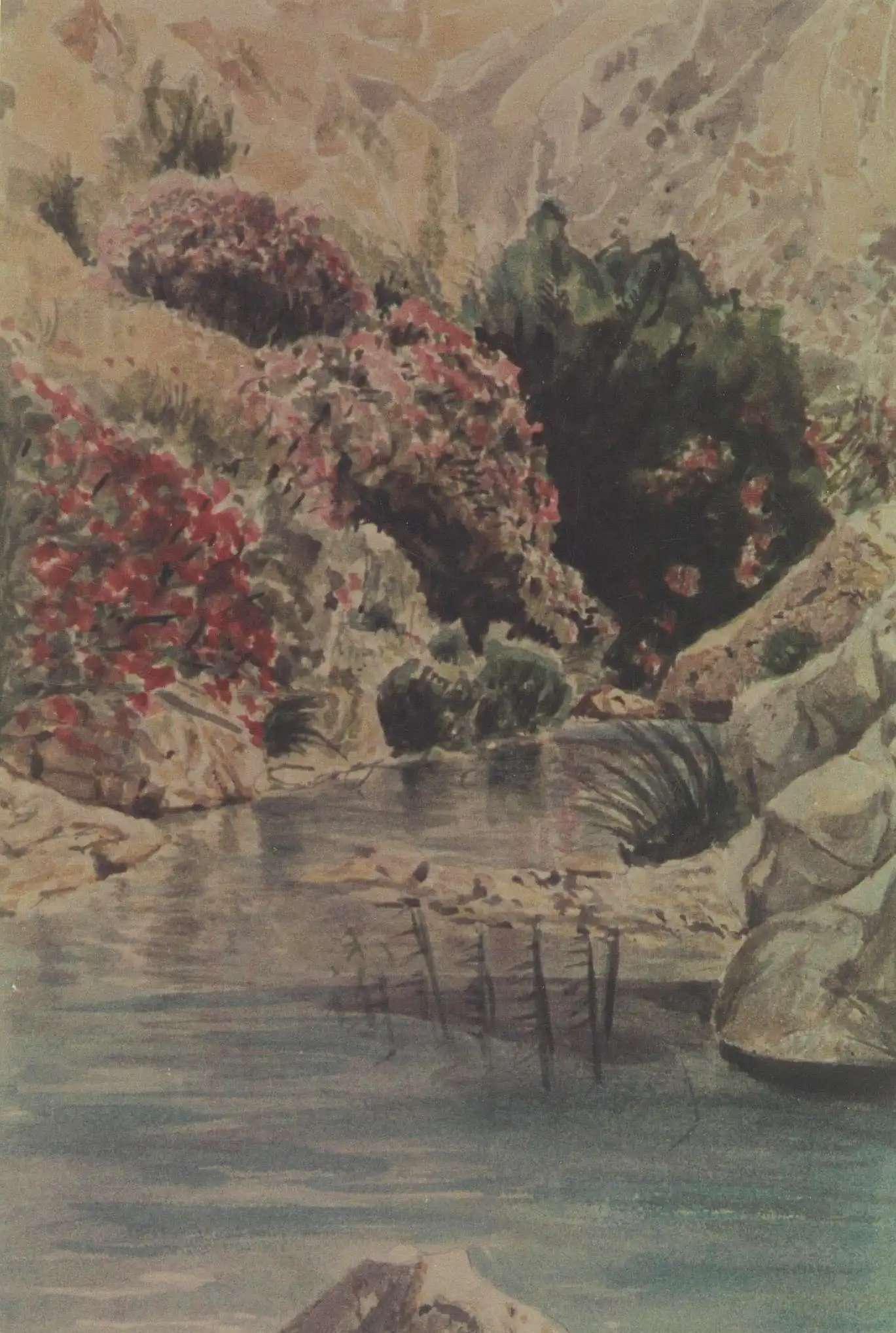
In his exhibition "Impressions from Wadi al-Wala," he returns to nature and to the roots of primal innocence. It is as if the artist Hani Hourani is searching for the "lost balance" between humanity and Mother Earth. He pours his passion into the colors of unity with the pristine Jordanian landscape, escaping the "slogans of modernity" towards "early Impressionism," where the interplay of "shadow and light" reigns supreme. It is as if he emerges from the darkness of his soul, opening it to the sun and fresh air. We can observe the following:
First, he uses watercolors for their smoothness and fluidity as they flow across the canvas without artificial or technical constraints. The vibrant, romantic colors are a fitting choice, resonating with the pristine nature and its qualities. These colors are fluid and gentle, far removed from harshness. He also uses acrylics in some paintings, such as "Salt" or "The Mountains of the South," in a way that complements the textured surface of the canvas and reflects the contours of life: a vibrant nature, abandoned houses in the open expanse of nature, and a silence that speaks volumes of desolation. However, the artist uses color to break the photographic quality of the painting, so as not to judge it by its conventionality. He transforms this conventionality into simple, concise symbols in the trees, flowers, and abandoned houses.
Secondly, he plays with the interplay of light and shadow, as this is fundamental to his interaction with nature. He distributes light and shadow in a perfectly balanced way, as seen in his painting "Trees," and also in "Vietnamese Village." He maintains a middle ground between light and shadow, where neither overpowers the other.
Thirdly, the most important aspect of the "Impressions from Wadi al-Wala" exhibition is the artist's ability to distribute masses with balance on the surface. He tends towards a system of two basic masses, but he sometimes breaks the duality by focusing on a single mass as the focal point of the painting. He rarely employs a three-part system. His interest in mass is evident in paintings like "A Bush in a Rock," where life springs forth from the rock. The artist also tends to create longitudinal fissures in the surface, which express the duality of the soul, as seen in "Petra's Sale" or his painting "Algerian Window," among others.
Fourth: If "humanity" is absent from these paintings, it is because the dialogue within the artwork is achieved between the solitary artist and pristine nature—a duality of presence and absence. Thus, the dualistic dialectic transforms into an individual love for places, an escape from the "triad of presence: artist, place, and people." The present absence is an expression of a rift in the relationship, a first positive individual step, which may be followed by others.
Therefore, Hani Hourani is a romantic, individual artist inclined towards duality, searching for balance in nature and in the fractured soul.
Ezzedine Al-Manasra
Al-Rai 12/17/1993