EssaysNovember 11, 2026
Articles about Hani - Inorganic matter pulsates in the artist's works
Hani Hourani16 min read
Inorganic matter comes to life in artist's photos
Ica Wahbeh
Jordan Times
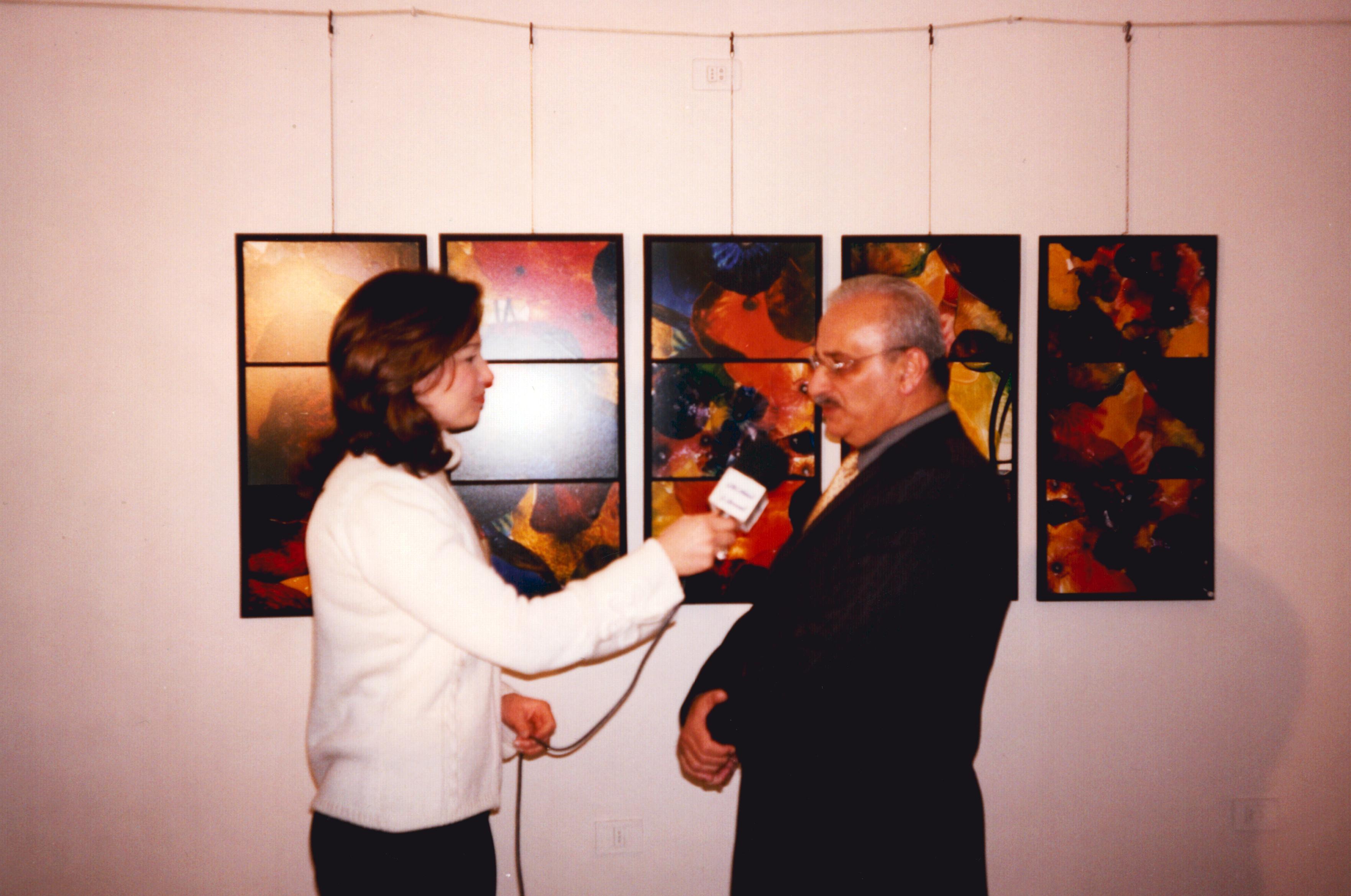
norganic matter is given life, cabalistic signs become birds in flight, and colour and I texture combine to surprise the unaware viewer who wonders what abstract or naïve artist produced the images. Yet, the photographs exhibited are not copies of some painter's canvases; they are real camera snapshots of places and things immortalized by an artist with a sharp, extremely aesthetic eye.
Always on the move but always aware of the beauty around him, Hani Hourani proves that the tiniest detail, combined with mastery of the photographic art and artistic imagination, can become an image that speaks volumes, that enchants the eye and that could easily be taken for the skillful stroke of brush of a master painter.
Cold stone is given warmth and life by texture and amazing colour combinations that only come to show that nature will always humble man, surpassing him and teaching him lessons every step of the way. But if stone walls in nature (Petra, in one case) or houses usually mean just that to most passers-by, Hourani has the merit to go beyond the obvious, to the not so hidden, yet for many invisible, to capture a few square centimetres of slate and turn it into art. Forming sharp geometric shapes or intermingling sensuous figures, turbulent, blurry outlines or fossilized structures, the colours of the stones he photographed are rich, unexpected, amazing, mesmerizing.
And stone is not the only element irradiating warmth and life in Hourani's pictures. Metal - hard, decaying and cold can surprise by the shapes and colours it takes, by its coming to life at the touch of Hourani's magic eye. And water, symbol and source of life, can assume sinuous, organic or lunar landscape contours when spots of light rest on its surface, forming enigmatic symbols of contrasting colour.
Colours in most shots are earthly: ochre, beige, stone, gray, teal, magenta, green. In the case of man-made walls and ceilings, colours are an imitation of those of nature, with an added touch of pastels and natural molds and deposited ore.
Looking at the photos, one gets a case of "why didn't I think of it". Sort of a reverse Columbus egg, with a tinge of green for envy. But the fact remains that Hourani is incontestably an artist. One who recognises the artistic value of an object and uses his talent to reveal and enhance it.
And besides "documenting" his finds, he also gives a chronological account of the time and place when he was contemporary with the objects caught still by the camera. The walls and ceilings of some of the houses he photographed may not last long after he saw them. The decrepit state of some shows they are about to crumble and become the inert matter from which they came into being. Others, sturdier and showing signs that they weathered time, may defy age for many years to come and tell their story to future generations willing to bend an ear (or lend an eye). Whatever the case, Hourani was there first and his silent images tell the story. Rich, warming, profoundly aesthetic.
'Windows and Doors'
Hani Hourani's vision of the past
By Ghassan Joha
Star Staff Writer
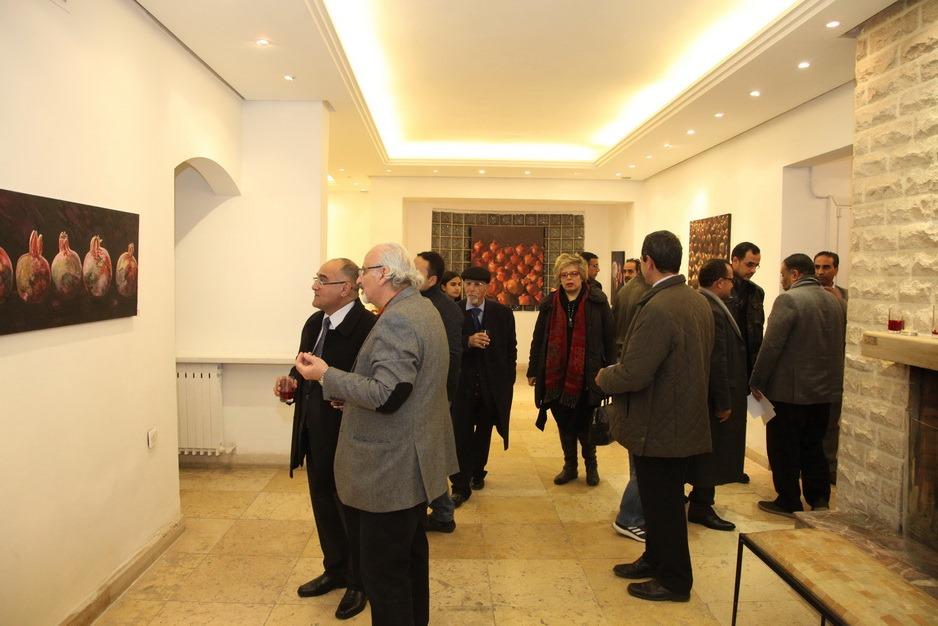
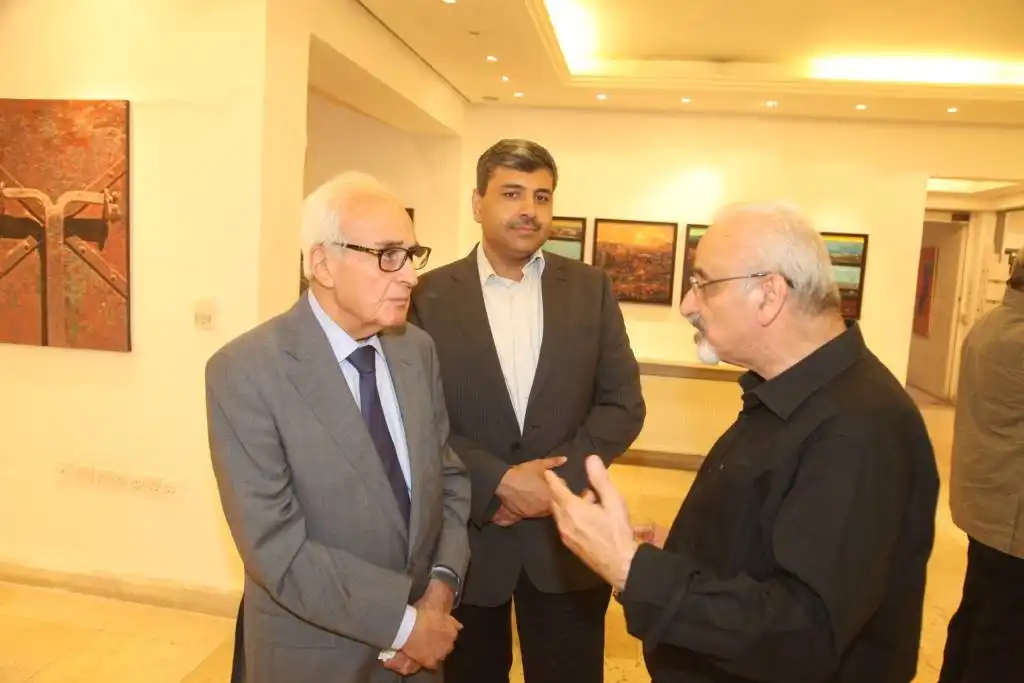
H ISTORY IS associated with images that brings the past into life. Jordanian artist Hani Hourani recently opened a unique photography exhibition at the Baladna Art Gallery in Wasfi Al Tal Street. 'Windows and Doors' simply narrates history through photography.
The exhibit, opened under the patronage of Amman's Mayor Nidal Al Hadeed, displays 76 large and middle-size photos of old and traditional buildings from various corners of the Arab world.
The objective is to uncover the past while integrating the present, to pursue reality without depriving the images of their historic values.
The combination of interpretations that are visible in these photos portray the abstract cultural aspect of old buildings which date back to many years. The artist takes us on a ritual trip of traditions in north Africa and the Middle East
Hourani concentrates on the traditional atmosphere of history by using important details such as antique doors and windows.
His current exhibit is considered unique because it displays pictures of monuments that no longer exist. These monuments use doors to venture into the past and windows to forsee the present and future. Doors are mainly made of either wood or metal creating a vivid scene in each photo of different buildings. Windows on the other hand, invite us inside homes through the reflection of the penetrating light.
Shadows of old doors and arches in Tunisia and Morroco add a touch of liveliness to the pictures.
Windows, however, are portrayed in different shapes and styles holding within them all the secrets of the past in an association with the present.
Egyptian oriels which are windows projecting from the walls and supported by corbels or brackets, introduce a unique style filled with Arabesque ornaments spread over the surrounded area. This kind of windows were common during the Islamic and Ottoman periods.
Churches and mosques are also featured. These sacred places force an atmosphere of holiness and secrecy represented in bell-towers and minarets. Hourani's sensitivity is evident in his work, since they draw the viewer to the roots in which the truth lies and history preserves its sacred values. The exhibition also sheds light on the significance of the house as a vital element for social relations.
Hani Hourani held his first exhibition in 1996 in Baladna Gallery which paved the way for further shows around the Kingdom. Born in 1945 in Zarqa, Hourani obtained a bachelors degree in 1970 in Political Science from the University of Jordan. He pursued photography courses at the Lebanese Ministry of Information in Beirut in 1974 and in Moscow in 1975.
The artist has been the director of the New Jordan Center, since 1992. The artist chose to hold his current exhibition at Baladna Gallery to pay tribute to the House that gave him his first opportunity. 'Windows and Doors' runs till 18 December.
Building a relationship between man and the city
By Munther Hamdan
Star Staff Writer
Star-8/8/1996
rab and Islamic culture is highlighted through the photography exhibition of Mr. A Hani Al Horani currently displayed at Baladna Art Gallery. Entitled "people and Places", the exhibited works are truly representative of the everyday life in Arab and Islamic settings.
The show consists of pictures which celebrate the traditional aspects of the modern Arabic city. Al Hourani's creativity lies in his ability to transform ordinary scenes found in everyday life into expressive pictures. They are far from passive even when they portray silent buildings.
It is the dexterity of the art ist photographer which enables him to breathe life into the rock, using his insight and modern techniques of photography. Choosing the right angle and time to shoot made Al-Horani a real artist.
His photos are documents which chronicle the history of places and the habits of ordinary persons. With photos of Cairo, once known as the city of Minarets, he takes the viewer into the prosperous eras of past Islamic civilizations. Some shots of mosques date back to the Mamluk period of Islamic history. The artists is trying to reflect the might and greatness of those constructions and how they stand in modern time.
The art presented requires more than using the camera an instrument. The artist should be able to penetrate into the hidden meanings of the scene he wants to shoot and thus magnifying those aspects, which he deems most important and conceals those, which are irrelevant. This needs a sophisticated photographer who can read the faces of people and create pictures, speaking their desires and feelings. These can be the truest moments of expression.
Al Hourani's pictures are either colored or black and white. Most of these which represent people shopping or smoking the argileh in the local, traditional markets of Cairo and Damascus, are taken in color. They convey a live and vibrant life with so many people bargaining, walking and/or in Jerusalem are meant to reflect a sad mysterious vision of places still under occupation.
Horani's photos, as he said are the production of many visits to Arab and Islamic countries. "Though: many of these pictures have been shot under the influence of certain moments or ironic situations, the exhibition on the whole is seeking to trace the reality of the Arab and eastern city", he added.
Horani stressed that his aim is not to portray the nostalgic past or those attempting to revive it, but he wants to strengthen the relation between the human being and the place he lives in. "There should be an intimate relation between the people and the places they are living in instead of looking upon these places as being only for residence".
Being a political researcher does not lessen the quality and sensitivity of his works. He graduated from the University of Jordan in 1970 majoring in political science. He then took courses in photography at the Lebanese Ministry of Information.
He worked as a journalist and researcher since the beginning of the seventies until 1991 when he became editor of the Al Urdun Al Jadeed quarterly.
He is also now the head of the Al Urdun Al Jadeed Research Center.
Celebrating the ordinary:
Experiments with space, time and people
By Mahmoud I. Mufti
Special to the Jordan Times
AMMAN Dr. Hani hourani's pictures do not attempt to dramatise the dreary, but to 25 celebrate the ordinary. Whereas most photographers would be content to limit themselves to either colour or black and white photography talent being a limiting factor Dr. Hourani tackles both disciplines with incredible sensitivity to the potential and to the limitations of each. Invariably some are more evocative than others, in both categories, but none can be said to be bland. In fact this artist approaches the subject matter in a manner of artistic intimacy which is immediately communicated to the viewer, imparting the sense allegorically speaking, that these are "hand-made" photographs rather than "machine-rolled", much in the crafts-man patiently his violin. It may be his hundredth, but it is crafted with the same loving meticulous care as his first.
Similarly, Dr. Hourani's success in his exhibited photos also numerous - lies not in the way he addresses the many variables of credible photography, such as light, focus, etc., but in the way his photographs are infused with a sense of history and documentary prowess. He achieves this by not only choosing interesting subject matter, but also by interestingly choosing his angle of shooting, the time of day, and even the non-pinnable notion of mood. Because this is exceedingly hard to achieve at any level, some of his works speack out to the viewer more vividly, even passionately, than others.
And as if the challenge of understanding and harnessing the subtleties of both black and white and colour format is not amply insurmountable, the artist takes on the additional challenge of diversifying his choice of subject-matter into three major areas: People going about their daily lives, urban architecture, and landscapes (each of which can engage a photographer for and entire lifetime).
The effect of all this diversity is dazzling. In planning to visit this exhibit, and if you are a reflective, historically sentimental person, dedicate at least an entire hour for this visual and documentary feast. One needs at least that long to be guided, by means of the works, powerful evocations, through the hilltops and characterful streets of Amman and Salt, to the even tighter, rustic, cobbled alleyways of Jerusalem and its plethora of minarets and church spires. Beirut comes next with some aerial depictions of the coastal bays in the fog. We are later corrected and told that these are taken from atop the Carlton Hotel, and not from the air.
"There appears to be a comeback in our culture towards viewing society holistically.
incidence of people delving into academia the sciences, poetry, music, and the arts".
The splendorously ornate North African cities of Cairo, Maraesh and Tunis occupy a major section in the exhibit almost comprising a treatise on (the study of) minarets, mosque facades, more minarets archways, busy market places, and impoverished residential neighbour-hoods. Istanbul and other regions of Turkey follow, with shots of old villages made entirely of timber, as well as others depicting luscious gardens (including various shots of an artist's back garden... collaged walls and all).
Many of the works here make the viewer feel as if he/she would really like to be there. The coffee shop at Kan Zaman, for instance, is one such place: The sun, filtering through the loosely-woven reed ceiling of the enclosure creates and elaborate embroidery of shades and shadows on the rough stone floor, mirroring the fibrous matrix above. The atmosphere is one of a tranquil spring morning, well before the arrival of the first luncheon-sniffers. Only several waiters in the in the extreme horizon of the walled cafe are apparent. But in one corner, one is able to discern a stack of "argeelehs" (one-metre-high traditional Arab-Turkish water pipes). In the diffused sun, and with the protective wind-blocker metal caps atop each one, they altogether look like small Roman Legionaries with spit-polished pewter helmets.
However, it is the photographs which combine both people and their urban settings, in this writer's opinion, that are most vividly able to touch the viewer. Two pictures hung horizontally next to each other recount one of the most typical tales of urban life, the "agreelch ritual". Wafting in the smoke of the agreelch's "tumbac" (a pungent blend of), three young men sit back and relax in an outdoor frescoed corner of a Damascus cafe on a Friday morning before noon prayers
The atmosphere is over whelmingly one of total equilibrium with the physical surroundings; a metal-grates window and palm trees and a mosque painted on the wall just behind them, (hence the allusion to the frescoes).
While there is an assumed sense of camaraderie among argeeich-smokers gathered together, the characters in the photograph seem content to just sit there and contemplate life, (though one of them looks as if he is truly better off not contemplating his own life).
Details aside, however, what Dr. Hourani has achieved in this shot (and others involving people in urban street settings), is to capture a particular genre of mood; one that is far from contrived. It is a mood that enables one to see how true these characters are to themselves and to feel that the scenario is not one where these people simply "fit" and "fade away" into the background. Rather, it is a case where they are the principle players in the frame; the artistic reference point; the aesthetic anchor.
Accordingly, the background finds itself in need to "keep up", as it were, with the atmosphere of authenticity generated by the characters,
Commenting on what most viewers and fellow photographers would most likely describe as an "over-thematic" approach to a photography exhibition, the artist says: "There appears to be a comeback in our culture towards viewing society holistically. In the old days, there was a much greater incidence of people delving into academia, the sciences, poetry, music, and the arts. This has the advantage-providing the talent is there to view the world and society from different angles and from different binoculars.
Dr. Hourani's talents extend to research and academia. He heads the Al-Urdun Al Jadeed Center (The "New Jordan Center). He and his wife, Suad Issawi Hourani, are also the owners and directors of the Baladna Gallery in Wasfi Tel Street. The exhibition runs until the evening of August 26.
Gothenburg: A meeting Point
"In his coloured photographs, Hani Hourani captures space in depth in accordance to the laws of perspective. Yet out of his choice we also see windows, doors and walls that bring space out to the depths and up to the surface. The dialogue of the two types of space brings about the aesthetic pleasure as per communicating with the photographs*".
Quoted from: "The Gothenburg a meeting point exhibition brochure, Konsthallen in Gothenburg, Sweden, 1999.
Documenting history through human life
Ica Wahbeh
Jordan Times
If Hourani's fascination with nature seems overpowering, a long, curious look at his photographs of people reveals a man extremely interested in fellow human beings and exceptionally talented at immortalizing them in "telling" postures or in the foreground of some monumental works.
Instances, postures, poses, gestures, portraits or group photographs, they all tell the story or portray the life of those in the shots.
Of young or old, of black, Asian or white, of people idle or hard at work, images are magnetising, they capture the viewer and hold the eye in the desire to decipher the "beyond", to catch the soul.
What is the young girl studying? What is this man intent on his paper reading? Why is this man alone on the pier? What stories do the two old man on a bench tell? Who is this pretty girl watching? Is the fish this man is cleaning freshly caught? If so, was it caught earlier in the morning by this fisherman mending his net? The cigarette is burning and the ashes are growing longer. What is the young man smoking it so intent on? I've had enough talking to you, let me watch the traffic, a far easterner seems to be telling his bench mate in Marseilles. Lost in the city? Just read the map! Let me help you cross the street, mother.
Faces, smiles, bodies, activities, inexorable looks, intellectual demeanors. People posing or caught unawares in a moment of their life that has been rendered immutable by the simple click of a button. By someone who knew what he was looking for in a fellow human being: life in a simple manifestation.
In another album of photographs, the characters are no more black and white. They are people in Arab cities, taken, at times, against a background of breathtaking beauty and colour.
Blue doors and benches, ochre shop blinds, raspberry walls, ornate wrought iron balconies, arabesque decorations of filigree mosaic, lush foliage, elaborate gates, white walls, doorways, souks, stones, ruins. These all contribute to embellishing the still image of one or a group of people allowing themselves to be photographed. And complementing the background colours, the garments worn by those in the frames are invariably coloured, or contrasting, from the purest white.
against a fairy tale background to the brightest reds, yellows and greens against desert stone. A few of these pictures are black and white and they appropriately represent the time and place of veiled women and turbaned men.
The mood is mostly gay and cozy, the smiles talk about parents happy to show off their offspring or men happy to display the trade they play.
The pictures are not only a reminder to Hani Hourani of the places he visited and the people he met. They are, again, a fragment of history left for posterity by a cognizant artist with a feel for art, colour and place.