EssaysNovember 11, 2026
Articles about Hani Oman - Ica Wahbeh
Hani Hourani5 min read
Activist's paintings preach return to nature
By Ica Wahbeh
Jordan Times, Staff Reporter
Jordan Times-29/12/1993
AMMAN - Hani Hourani, a man with political ideals for which he once fought, thinks, in a world of changing values and political upheavals, that after all has been said and done the best thing is to return to nature, to the pure, unadulterated values of life.
So his water-colours, attesting to a great talent and mastery of the brush, render simple messages, "not charged with political meaning, as most would expect" of nature and peaceful villages with an idyllic life, unperturbed since biblical times.
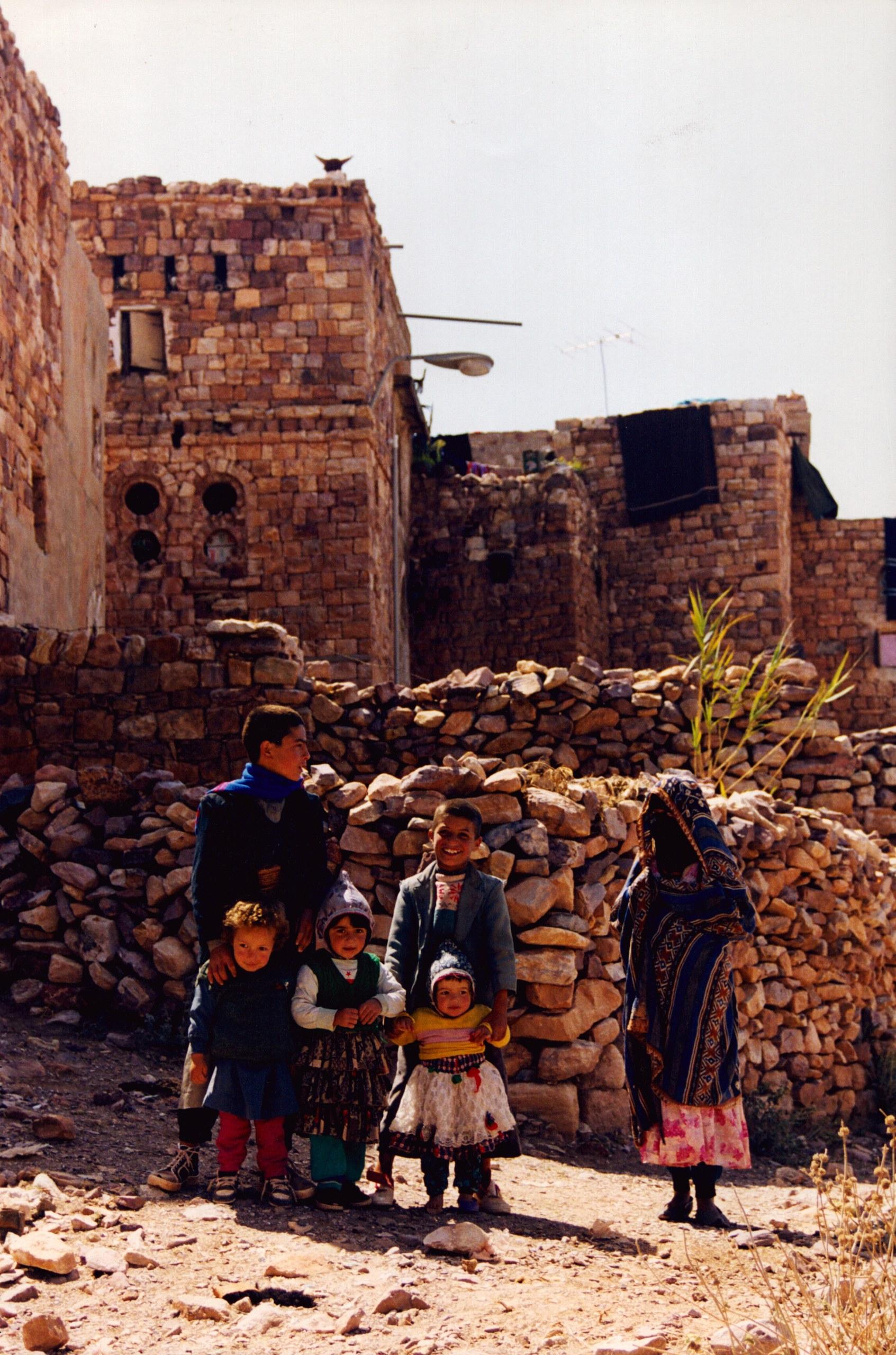
The villages, whether in the north, Spera, in Salt or in Syria, Algeria or Vietnam, faithfully reproduce the life of people untouched the life of people untouched by modern civilization, with houses basking in the sun or sheltered by the shadow of trees, with patches of wheat or fruit trees strewn among them and with the feeling of life come to a standstill.
Colours are calm, soothing local characteristics are preserved, the viewer integrates in the village life, walks the dirt roads between the houses, rests in the fields or moves busily among the industrious Vietnamese.
In the group of Wadi Al-Wallah landscapes, a clear blue stream meanders around boulders whitened by the sun, shadowed by timid, slender reed stems or guarded on either side by red and pink oleanders.
Blue skies hang over an almost barren land with, here and there, a daring tree pushing its roots deep in the stone in the desire to survive, or patches of lush green vegetation by the water rejoicing the eye, offering if a fresh distraction from the arid surroundings.
Petra, one of Jordan's landmarks, is pictorially represented, the dark narrow opening of the siq inviting to adventure and discovery.
A still life and two expressive portraits, of the artists father and of a young woman, make the transition to the earlier stage of the painter's works, that of ink sketches of bodies in different postures and of two oils.
The oils are of a woman clad in black velvet, with hands crossed in her lap, sensibly staring into the horizon and of a peasant sitting on a wooden crate, with a sac of apples and a child playing at her feet and, in the back ground, houses hidden among trees.
The oils are darker in colour the features are stronger and the mood somber.
The latter works (water-colours) are pastel, reflecting a state of mind that has come to terms with itself and decided return to nature is the solution.
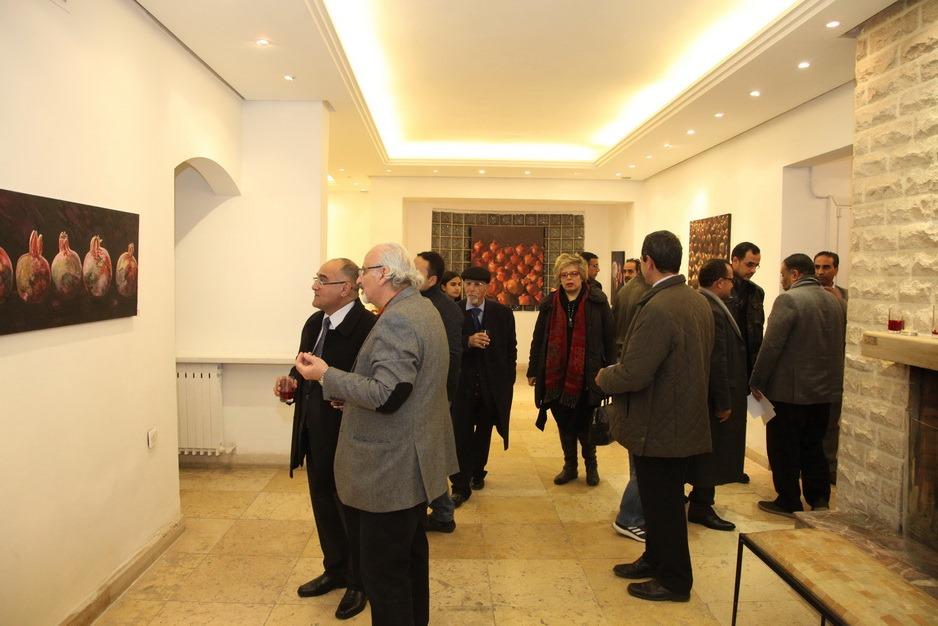
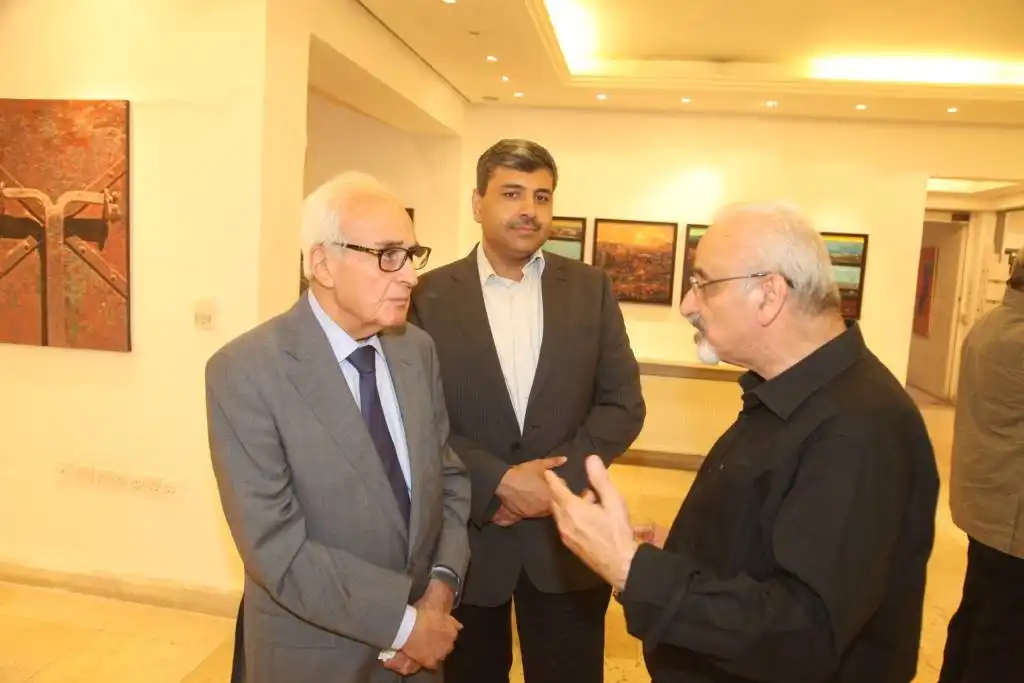
The exhibition, at the Baladna Art Gallery opened on Dec. 14 and will last until Dec. 31.
Inorganic matter comes to life in artist's photos
Ica Wahbeh
Jordan Times
norganic matter is given life, cabalistic signs become birds in flight, and colour and sexture I combine to surprise the unaware viewer who wonders what abstract or naive artist produced the images. Yet, the photographs exhibited are not copies of some painter's canvases, they are real camera snapshots of places and things immortalized by an artist with a sharp, extremely aesthetic eye.
Always on the move but always aware of the beauty around him, Hani Hourani proves that the tiniest detail, combined with mastery of the photographic art and artistic imagination, can become an image that speaks volumes, that enchants the eye and that could easily be taken for the skillful stroke of brush of a master painter.
Cold stone is given warmth and life by texture and amazing colour combinations that only come to show that nature will always humble man, surpassing him and teaching him lessons every step of the way. But if stone walls in nature (Petra, in one case) or houses usually mean just that to most passers-by, Hourani has the merit to go beyond the obvious, to the not so hidden, yet for many invisible, to capture a few square centimetres of slate and turn it into art.
Forming sharp geometric shapes or intermingling sensuous figures, turbulent, blurry outlines or fossilized structures, the colours of the stones he photographed are rich, unexpected, amazing. mesmerizing
And stone is not the only element irradiating warmth and life in Hourani's pictures. Metal hard, decaying and cold can surprise by the shapes and colours it takes, by its coming to life at the touch of Hourani's magic eye. And water, symbol and source of life, can assume sinuous, organic or lunar landscape contours when spots of light rest on its surface, forming enigmatic symbols of contrasting colour
Colours in most shots are carthly: ochre, beige, stone, gray, teal, magenta, green. In the case of man-made walls and ceilings, colours are an imitation of those of nature, with an added touch of pastels and natural molds and deposited ore.
Looking at the photos, one gets a case of "why didn't I think of it". Sort of a reverse Columbus egg, with a tinge of green for envy. But the fact remains that Hourani is incontestably an artist. One who recognises the artistic value of an object and uses his talent to reveal and enhance it.
And besides "documenting" his finds, he also gives a chronological account of the time and place when he was contemporary with the objects caught still by the camera. The walls and ceilings of some of the houses he photographed may not last long after he saw them. The decrepit state of some shows they are about to crumble and become the inert matter from which they came into being. Others, sturdier and showing signs that they weathered time, may defy age for many years to come and tell their story to future generations willing to bend an ear (or lend an eye). Whatever the case, Hourani was there first and his silent images tell the story. Rich, warming, profoundly aesthetic.